
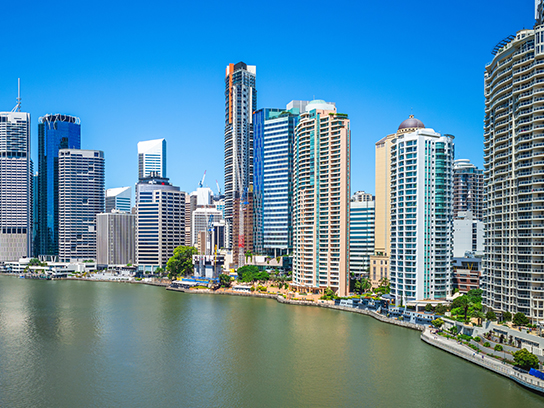
South-east Queensland’s population is set to reach 4.5 million by the time Brisbane hosts the 2032 Olympics, new analysis shows, despite rising property prices driven by a lack of supply.
Analysis of Australian Bureau of Statistics data by KPMG reveals the population in the south-east corner has grown by as much as 2.2 per cent over the past five years, above the national average of 1.5 per cent.
“You’ve got people coming from expensive Sydney or dreary Melbourne or those small cities around the country, and also it’s pulling people from places like Darwin and Cairns,” KPMG urban economist Terry Rawnsley said.
The analysis forecasts the south-east Queensland population will be as high as five million by 2036.
But not everyone is flocking to Brisbane, with more than half of the growth happening outside the state capital.
In the last five years, 68,000 new residents called the Gold Coast home, 61,000 in Logan and Beaudesert, 51,600 in Ipswich, and 47,500 more on the Sunshine Coast.
“What we are seeing in Brisbane over a long time is the inner-city suburbs have got more and more expensive, and more and more people are being pushed out to those growth areas in Ipswich and Logan,” Mr Rawnsley said.
Trinity and James McNicol made the move from the Brisbane suburb of Newmarket to Purga in Ipswich in 2021, swapping a small Queenslander for a four-bedroom house and 100 acres of farm land for a comparable price.
“We can combine what we love outside of work, still have our jobs in the city with a reasonable commute distance, but have a bit more space,” she said.
“You have got everything at your fingertips. It is the perfect combination of having the space, the lifestyle, a bit more peace and quiet, but still having absolutely everything you need.”
Interstate migration is also driving unprecedented growth, with more than 22,000 people moving to the south-east from other cities.
However, Mr Rawnsley said the flow of people moving from Sydney to Brisbane had started to slow over the last three years as Queensland’s property prices caught up.
Data from Cotality reveals unit prices in Brisbane rose by 2.2 per cent in November and house prices grew by 1.8 per cent, while property prices rose 12.8 per cent in 12 months.
The city’s median home value has reached $1,015,767, which is the second highest in the country behind Sydney.
REA Group senior economist Eleanor Creagh said while prices were continuing to rise, the “silver lining” for those trying to buy a house was that the pace of growth was no longer accelerating relative to the same time last year.
“The supply of new housing is certainly not keeping up with the demand at the moment,” she said.
“As a result, we are seeing that those fundamental drivers remain in play with continued upward pressure on home prices.”
The increase in rental prices is the most significant cost pressure on household budgets, according to the Queensland Council of Social Services’ (QCOSS) 2025 living affordability report, which is based on 1,017 responses to a survey.
Single mother Logan Bell had to move to Brisbane to seek housing support for herself and her seven-year-old child after sleeping rough.
She said despite working two jobs and receiving Centrelink payments while studying, she was unable to find a place to live.
Ms Bell has now found a place with another person who can contribute to rent, but is still spending about 50 per cent of her weekly income.
“It was devastating on my part, but when I was going to inspections and in emergency accommodation there are so many other disadvantaged families like myself and there is nothing more they can do,” she said.
“You are constantly in this vicious cycle of not being able to get ahead and it is not because I’m lazy or I’m not working enough. I was working as many physical hours as I could — [it was] still not enough.”
QCOSS chief executive Aimee McVeigh said when looking at vacancy rates it was “virtually impossible” for a family on a low income to secure an affordable rental.
Christopher John, who is chief executive of Logan-based support service YFS, said rent in the city had increased by 69 per cent in four years, taking the median rental from $350 a week to $590.
“In a community where we have 149,000 people on the lowest 20 per cent of income, [that] has really led to pressures of affordability,” he said.
Source: South-east Queensland population to reach 4.5 million as growth outpaces that of the nation, KPMG analysis shows, Claudia Williams for ABC News